

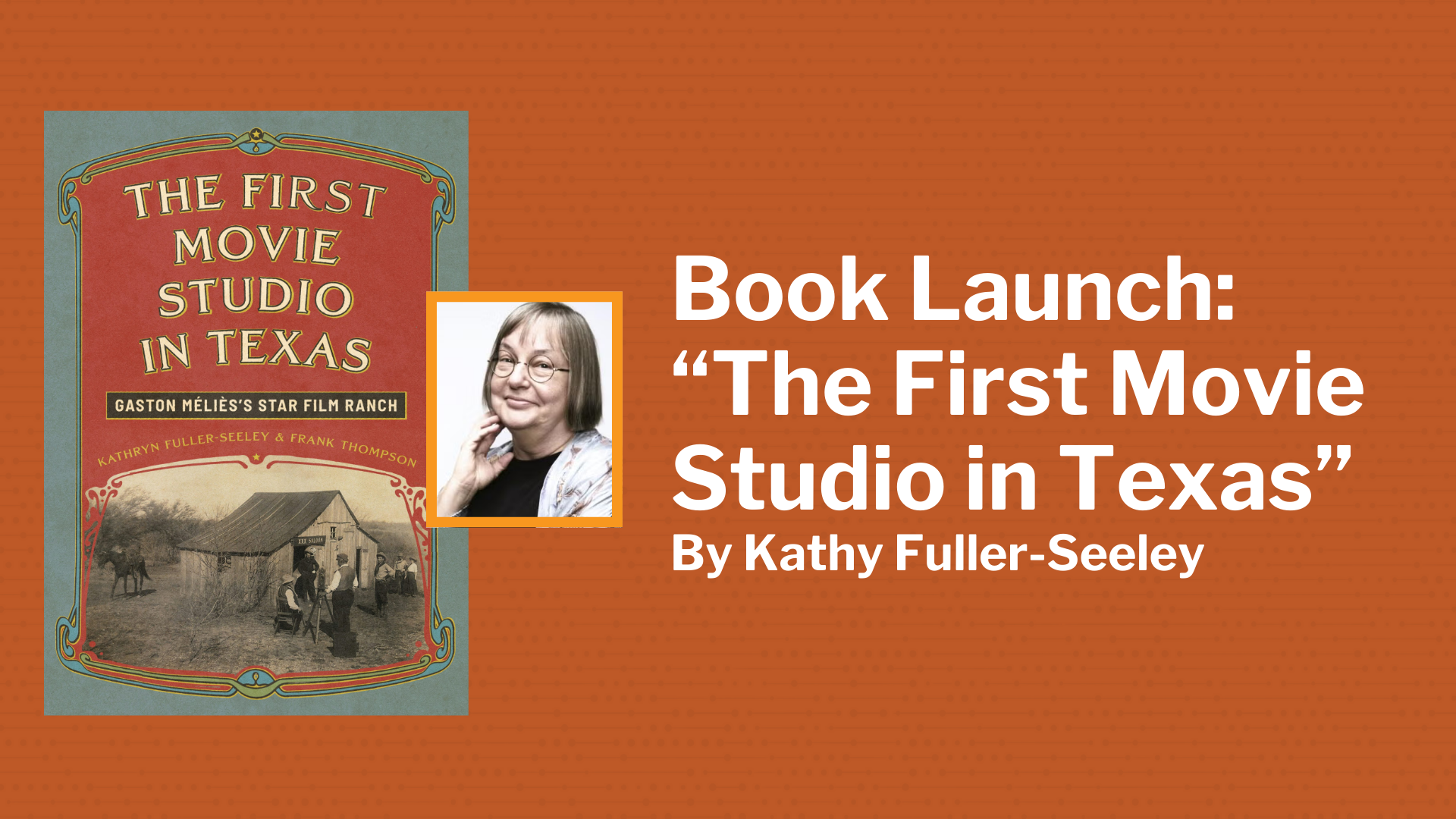
The Department of Radio-Television-Film is proud to announce the launch of Professor Kathy Fuller-Seeley's latest book, The First Movie Studio in Texas: Gaston Méliès’ Star Film Ranch 1910-1911. Please join us for a reading from the book and a Q&A with the author followed by a light reception.
Texas-produced in films in 1910-1911 burst the confines of the first New York-centered industry. Gaston Méliès (US distributor of brother Georges’s productions) saw the decline of fantasy subjects. Gaston gambled that westerns shot in an authentic setting would attract nickel theatergoers. He thus established the Star Film Ranch studio in San Antonio, choosing cinema’s earliest cameraman “Daddy” Paley for his experience, and hiring gifted young film actors, along with a half-dozen local cowboys. The company’s 70 action-filled comedies and melodramas of southwestern ranch life won critical praise, large audiences and substantial profits.
Geography, history and climate contributed to the thriving of the Méliès Star Film Texas troupe. San Antonio was a vibrant transportation and communication center, the largest city between New Orleans and Los Angeles. Unlike Jacksonville, Florida’s backlash against the upstart film industry, the city’s business leaders welcomed Méliès. Brewer Otto Koehler promoted product placement – the troupe’s saloon sets were festooned with advertising signs for Pearl Beer.
The anonymous acting troupe included Francis Ford (who would later train younger brother John Ford), and Edith Storey (who also played young boys); she was the darling of critics with her subtle acting and vivacious personality. In the films’ plots, (all filmed out of doors) plucky young women dashed madly across the prairies, rival suitors turned murderous, and English fops got their comeuppance from cowhands.
Production challenges abounded. The Patents Trust limited Méliès to one 1000-foot reel release per week. The troupe had to work at breakneck speed to meet Méliès demands for two finished films each week. Exposed film initially had to be shipped to New York before returning or editing. In 1911, however, Méliès brought developing and printing equipment to the Ranch. City leaders rejected filming of their ambitious drama The Immortal Alamo at the old mission, so it had to be recreated at the ranch. A dozen actors, with the aid of changing mustaches and hats, took four separate roles apiece.
Fast-changing industry conditions pushed Méliès to relocate to California in Fall 1911. His Trust-controlled films were soon eclipsed, however, by independent studios producing two-and-three reel, narratively complex features. In its moment, however, the Méliès Star Film’s Texas success contributed to the long-term development of the American film industry.
About Kathy Fuller-Seeley
Professor Kathy Fuller-Seeley’s research specialization focuses on American film, radio and television history and audience reception studies.
Fuller-Seeley is co-producer of Francis Ford, The Craving, plus Three Shorts, Blu-ray/DVD of restored rare silent films 1911-1919 created by the mysterious older brother of director John Ford. The disk includes her documentary, Francis Ford, Film Pioneer, (Undercrank Productions, 2024)
Fuller-Seeley teaches undergraduate courses on the historical development of film and media industries; gender and media in the 1960s; the study of contemporary comedy; silent film; Classical Hollywood stars and fans; and graduate courses in media historiography and media reception studies. She’s delighted to have received a “Texas Ten” teaching award in 2024 from the Texas Exes and The Alcalde magazine.
Details
Past occurrences
- February 26th, 2026 - 3:30pm to 5:30pm
Event Categories: Guest Speaker Lecture
Location: DMC 5.208
Other
Target audience: Alumni , Faculty , General Public , Staff , Students